
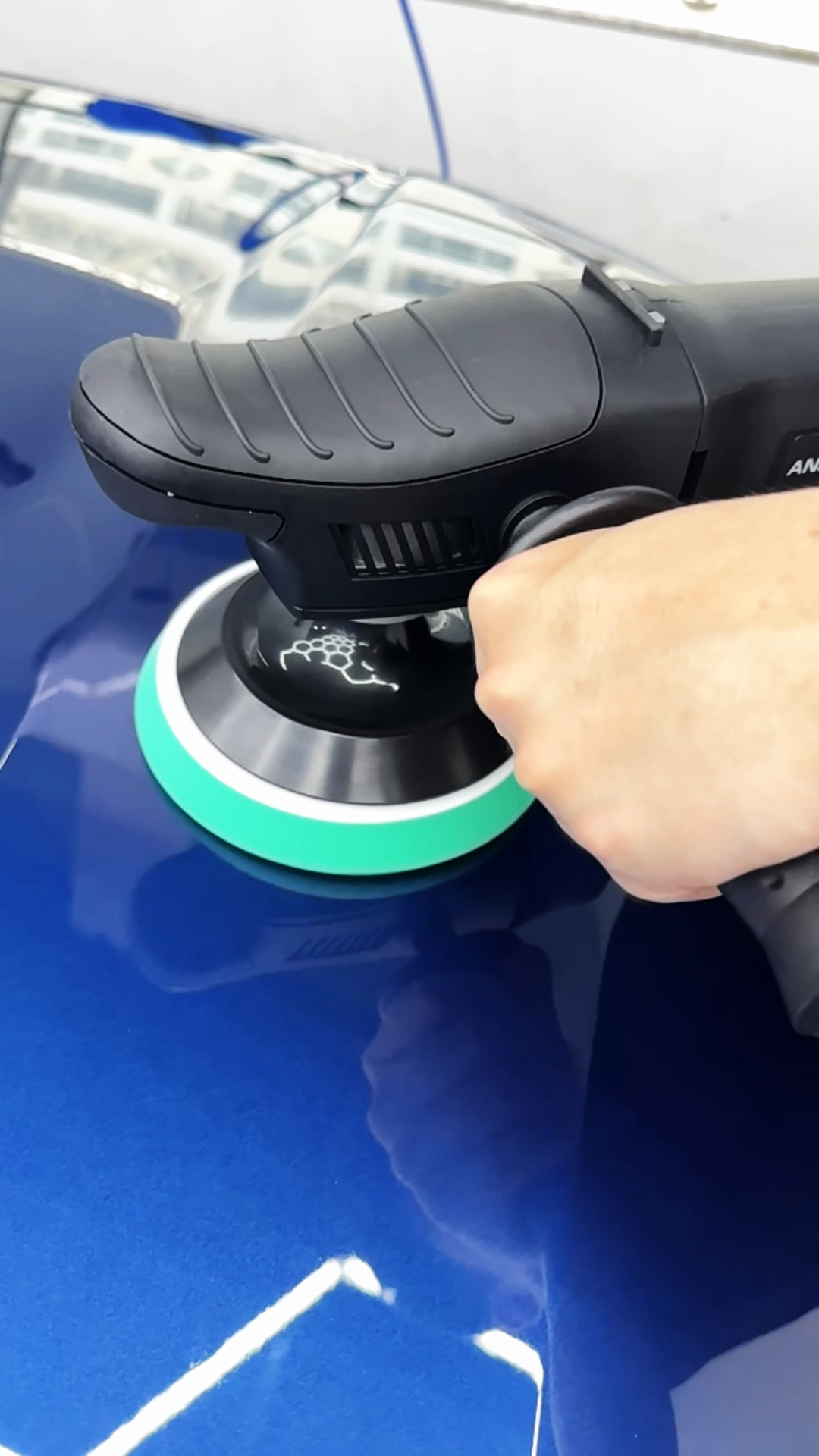
For car enthusiasts, detailing professionals, and DIYers alike, few tools deliver as dramatic a transformation as a quality automotive polishing machine. Yet with so many options on the market—rotary, dual-action, cordless, corded, pneumatic—choosing the right one can feel overwhelming. This guide breaks down everything you need to know about automotive polishers, from the basics of machine selection to the latest industry innovations shaping 2026 and beyond.
1. Why Use a Polishing Machine? The Case for Going Mechanical
Polishing a car by hand is labor-intensive and rarely delivers consistent results. Machine polishing, by contrast, uses a motor-driven pad to apply compounds with uniform pressure and speed, removing surface imperfections such as swirl marks, light scratches, and oxidation that accumulate over time and dull a vehicle’s paintwork. The result is a smooth, glossy finish that restores a vehicle’s appearance to showroom quality. Beyond aesthetics, proper polishing also protects the paint by removing contaminants that can lead to long-term degradation.
2. Choosing Your Polisher: The Three Main Types
Understanding the differences between polisher types is the first step to making the right choice. Here is a breakdown of the three primary categories:
Rotary Polisher
The workhorse of auto body shops. The head spins on a single axis in a regular circular motion, generating significant heat and friction that allows for aggressive paint correction. Rotary polishers are very effective at cutting and work faster than dual-action models, but they require considerably more experience to use properly. They can remove marks that dual-action polishers cannot, making them the tool of choice for professionals handling deep scratches and severe defects.
Dual-Action (DA) Polisher
Often the recommended starting point for most users. DA polishers combine rotational and orbital movements, significantly minimizing the risk of holograms and paint damage. The random-orbital motion makes them safer and more forgiving, especially for beginners. They are ideal for swirl removal, paint enhancement, and finishing work. For 90% of paint correction needs, a DA polisher is the safest and most effective choice.
Pneumatic Polisher
Lightweight and compact, these air-powered tools excel in tight spaces and detail work, though they offer relatively lower speed and torque compared to electric models.
3. Corded vs. Cordless: The Power Source Debate
One of the most significant decisions buyers face is whether to go corded or cordless. Cordless, battery-powered polishing machines are rapidly gaining popularity, offering greater maneuverability and ease of use compared to traditional corded models. Equipped with high-capacity lithium-ion batteries, these cordless devices provide professional-grade power without cable management hassles, making them highly appealing for both hobbyists and mobile detailing services. Corded models, on the other hand, offer unlimited runtime and consistent power delivery, making them preferred for shop-based professionals handling multiple vehicles daily. Battery platforms with higher energy density and better thermal management are now enabling sustained polishing under load. As battery ecosystems mature, buyers increasingly evaluate polishers as part of a broader platform decision that may include lights, extractors, and other shop tools.
4. What to Look for in a Quality Polisher – Key Features
Modern polishing machines have evolved far beyond simple spinning pads. Today’s best tools incorporate features that enhance both performance and user experience:
- Variable Speed Control – Allows adjustment of RPM to match the task, from slow wax application to fast defect removal.
- Digital Displays – Show current speed and battery status in real time.
- Vibration Reduction – Reduces user fatigue during extended sessions.
- Ergonomic Design – Lightweight construction and balanced weight distribution enable longer, more precise work.
- Smart Features – High-end models now incorporate automatic pressure sensing and heat monitoring to prevent paint damage.
5. 2026 Innovations: Where the Industry Is Headed
The automotive polishing industry is undergoing significant evolution, driven by advancements in technology and shifting consumer preferences. Here are some of the most notable developments in 2026:
Award-Winning Design
Mirka Ltd’s POLAROS RP 600 rotary polishing machine received a 2026 Red Dot Award for Product Design, recognized for its ergonomics, finishing performance, and usability. Released less than a year ago, it features advanced RPM control technology, a distinctive low-profile design, and digital connectivity through the myMirka app. Its gearless design enables more efficient power delivery and much quieter operation. The machine is manufactured in Finland and features modular construction that simplifies servicing and extends product life.
AI-Powered Intelligent Polishing
Shanghai-based Sophys Intelligent Technology has developed an AI-powered intelligent surface finishing system. High-precision 3D vision serves as the “eye” to recognize workpiece shapes in real time, proprietary ROBOPILOT software acts as the “brain” to dynamically plan polishing paths, and a highly compliant robotic arm with a six-dimensional sensing intelligent grinder executes the work. To digitize master craftsmen’s “hand feel,” the company developed a handheld intelligent grinder that automatically records parameters such as force and speed during operation, building a process database. The company has accumulated over 1,000 process models for different materials. Testing data shows the system achieves polishing accuracy within 0.8 microns, improves overall production efficiency by 40%–50%, and maintains a product qualification rate above 98%. The solution has been deployed at BMW and Seres.
Embodied Intelligence Robotics
Tusu Technology launched three new products in April 2026, including the LumiCraft embodied intelligence polishing robot. The device features autonomous mobility with SLAM navigation and obstacle avoidance, achieving positioning accuracy of 2 cm. It includes an intelligent abrasive library and automatic change system—old abrasive removal and new abrasive installation take just 30 seconds. The system also features a high-vacuum dust collection system with over 95% dust recovery rate. From defect detection to repair completion takes just one minute, with operational efficiency three to four times that of manual inspection and repair.
Automated “Inspection + Polishing” Integration
Hangzhou Yuyi, a subsidiary of Yisiwei, has developed an automated paint defect polishing system for automotive painting workshops. Combined with the company’s paint defect inspection technology, it forms a complete “inspection + polishing” automated solution. All machine vision sensors and automated polishing products used are standardized.
6. Essential Polishing Techniques – Tips for Success
Regardless of the machine you choose, proper technique is critical. Here are key principles:
7. Market Outlook: A Growing Industry
Market data confirms the sustained growth of the automotive polishing sector. The automotive polishing machines market in 2024 is estimated at approximately USD 2,050 million, with a projected CAGR of around 5.6% from 2024 to 2033. The broader car polishing machines segment was valued at US$6 billion in 2024 and is projected to reach US$8.7 billion by 2030. The global auto rotary polishers market was estimated at USD 2,937 million in 2025, with a projected CAGR of 4.00%. The electrical car polisher segment, valued at USD 130.12 million in 2025, is projected to grow at a CAGR of 7.47%, reaching USD 215.50 million by 2032. The car detailing market itself is growing rapidly, from $1.67 billion in 2025 to a projected $1.84 billion in 2026 at a CAGR of 10.3%.
8. Looking Ahead
As vehicle ownership continues to rise globally and consumer expectations for paint finish quality increase, the automotive polishing machine market is poised for sustained growth. The DIY segment, fueled by affordable and user-friendly machines, continues to expand the consumer base. Meanwhile, advancements in lightweight and energy-efficient motor technologies, along with the growing popularity of cordless models, further boost sales. Manufacturers that embrace innovation—particularly in cordless technology, ergonomic design, smart features, and AI-driven automation—will be best positioned to capture market share in this dynamic and rapidly evolving industry.
Post time: Jul-30-2026