
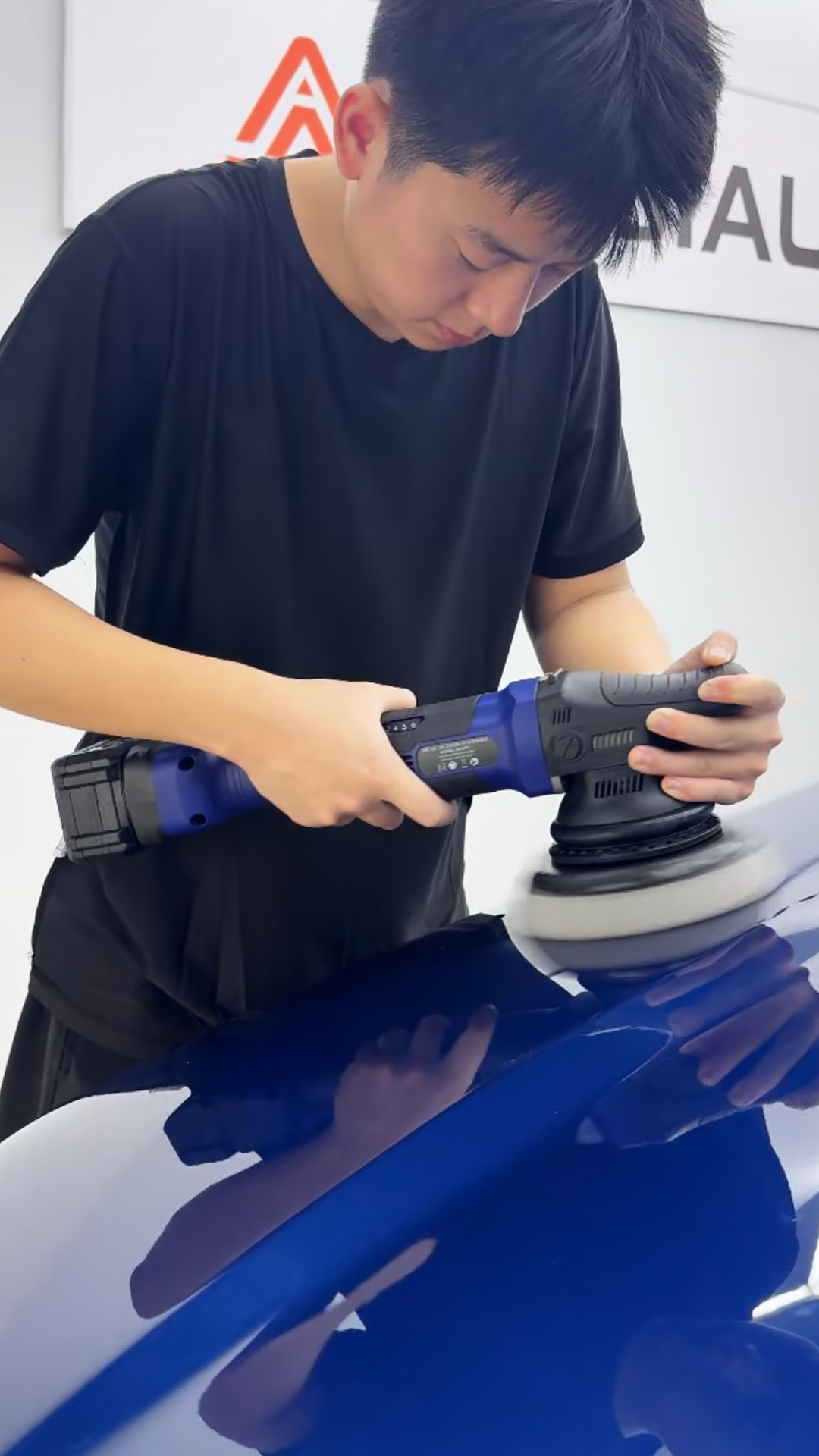
Automotive polishing may seem like a simple task, but it actually involves a sophisticated technical system. For an original equipment manufacturer of automotive polishers, understanding the technological evolution and application scenarios is not only a matter of professional expertise but also the foundation for better serving customers. This article systematically covers the core knowledge of automotive polishing machines—from basics and equipment selection to technical trends and industry dynamics.
1. What Is a Polishing Machine? – Basic Concepts
An automotive polishing machine is a professional power tool that uses an electric motor to rotate a sponge or wool pad at high speed. Together with polishing compound and friction against the paint surface, it removes contaminants, oxidation layers, and light scratches. Essentially, automotive polishing is “repairing by grinding”—it does not create new paint film but instead removes the damaged clear coat surface. A good polishing machine can restore a dull or scratched paint finish to a brilliant mirror shine.
2. How to Choose a Polisher? – In-Depth Analysis of Three Main Types
Polishing machines on the market fall into three main categories, each suited for different applications:
Rotary Polisher (RO)
Operating speeds typically range from 1,000 to 2,500 RPM. It offers strong cutting power and is ideal for removing deep scratches and severe defects, making it the tool of choice for auto body shops. However, it has a higher learning curve; beginners may leave swirl marks.
Dual-Action (DA) Polisher
Its motion is an irregular elliptical orbit, with rotation driven by friction. When resistance increases, the pad automatically slows down, offering excellent safety—beginners are very unlikely to burn through the paint. It is perfect for final finishing and routine paint maintenance.
Pneumatic Polisher
Lightweight and compact, suitable for polishing or waxing in tight spaces, but with relatively lower speed and torque.
Selection advice: For large-area heavy repair, choose a rotary polisher. For daily maintenance and final finishing, choose a DA polisher. For detail work, choose a pneumatic model. For DIY users, the DA polisher is the safest option.
3. Core Tips for Polishing Operations – Technique Sharing
A proper polishing process follows:
The vehicle must be thoroughly cleaned before operation—any residual particles can scratch the paint. The polisher speed should generally be controlled between 1,500–2,000 RPM, and it is advisable to test on an inconspicuous area like the hood first. Keep the pad perpendicular to the paint surface, move in overlapping circular motions at a steady pace, and do not work on any single area for more than 30 seconds to avoid overheating.
4. Industry Frontiers – AI and Automation Are Reshaping the Polishing Sector
If traditional polishing relied on a master technician’s feel and experience, the polishing industry in 2026 is undergoing a profound transformation driven by AI and automation.
AI “Replicates” Master Craftsman’s Touch. Shanghai-based company Sophys Intelligent Technology has developed a handheld intelligent grinder that allows experienced technicians to automatically record key parameters such as force and speed during operation, building a process database. The company has accumulated over 1,000 process models for different materials. Its integrated “brain-eye-hand” AI polishing system achieves grinding accuracy within 0.8 microns, boosts overall production efficiency by 40%–50%, and maintains a product qualification rate above 98%. This solution has been deployed at leading manufacturers including BMW and Seres.
Automated “Inspection + Polishing” Integration. Hangzhou Yuyi, a subsidiary of Yisiwei, has developed an automated paint defect polishing system for automotive painting workshops. Combined with its paint defect inspection technology, it provides a complete “inspection + polishing” automated solution. SpeedBot’s PaintPro system integrates 3D deflectometry imaging and AI detection to achieve fully automated online inspection and repair of vehicle paint defects through multi-robot collaboration.
Multi-Station Automatic Polishing Enhances Efficiency. Ningbo Jiebao Mingsheng Technology has received a patent for an automotive bushing polishing device that allows three bushings to be polished simultaneously, greatly improving production efficiency.
5. Market Outlook – Strong Growth Drivers
Market data shows that the global automotive polishing machine market was valued at approximately USD 2.05 billion in 2024, with a projected CAGR of about 5.6% from 2024 to 2033. The global rotary polisher market was valued at around USD 3.04 billion in 2025. The electric vehicle polisher segment is growing particularly fast, with an expected CAGR of 7.47% from 2026 to 2032. The global polishing robot market was valued at approximately USD 279 million in 2025 and is projected to grow at a CAGR of 11.10%.
Conclusion
From hand tools to electric machines, and from electric to intelligent systems—the technological evolution of automotive polishing machines never stops. For industry professionals, understanding equipment principles, choosing the right tool type, and mastering operating techniques are essential foundations. Meanwhile, keeping an eye on the practical application of cutting-edge technologies such as AI, automation, and robotics is the key to seizing early advantages. Whether for auto repair shops, detailing centers, or DIY enthusiasts, the right polisher can make any paintwork look brand new.
Post time: Jul-29-2026